 |
| 

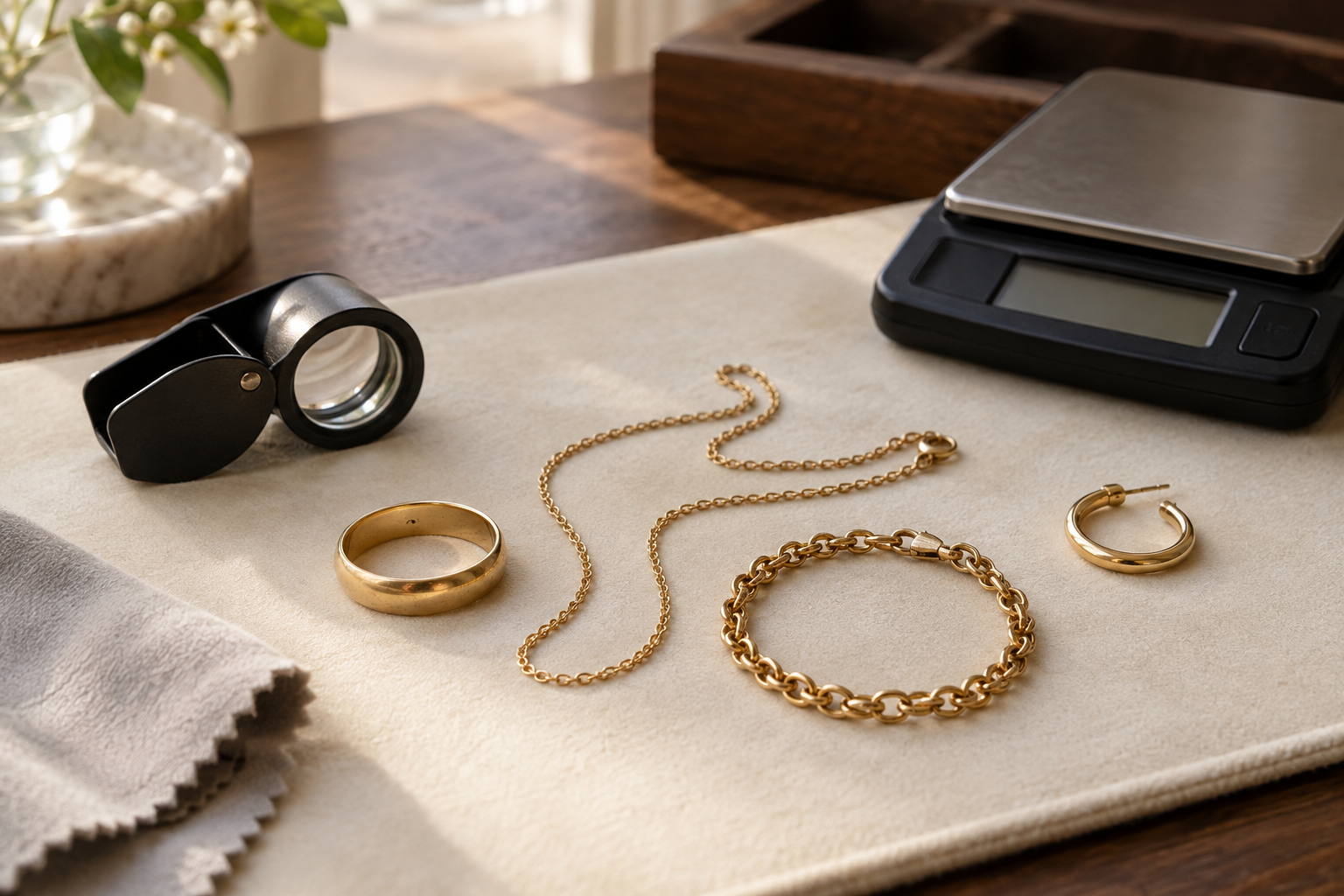
A Simple Guide to Weight, Karat and Gold Prices
Found an old chain, a ring you never wear, or an earring without its match? It’s natural to wonder: how much is my gold jewelry worth? You don’t need to know anything about gold to start finding out.
Your jewelry’s gold value mainly comes down to how much gold it contains and the current gold price. To work that out, you need two details: its weight and its karat, which tells you how much of the metal is gold. A buyer will also consider whether the piece has value as jewelry.
At Fancy Jewelry & Loan in Lawndale, we meet people who are surprised by the value in an old drawer of jewelry. We also meet people who expect to get back what they paid at a jewelry store. This guide explains what makes those numbers different—and how to get a clearer idea of what you have.
Start by looking for a small stamp. Check inside a ring, near a necklace clasp, or on an earring post. A magnifying glass or your phone’s zoom can help.
A mark such as 10K, 14K, or 18K is a clue that the piece is made from a mixture containing gold. A mark such as GP, GEP, GF, or RGP points to a gold coating or layer over another metal.
That difference matters. Two chains can look almost identical, yet contain very different amounts of gold.
The same gold mixture continues through the metal.
A thin gold coating covers a different metal.
A thicker, bonded gold layer surrounds another metal.
Gold plated jewelry has a thin gold coating. Gold-filled jewelry has a bonded gold layer over another metal; despite the name, it isn’t gold all the way through. A stamp such as 1/20 14K GF describes gold-filled jewelry, not a piece that is entirely 14K gold.
You may also see vermeil, which is gold over sterling silver. These items cannot be valued as though their full weight were the gold shown on the surface. The FTC’s guide to gold jewelry marks explains these labels in more detail.
A stamp is a useful starting point, but it isn’t proof. Marks can wear away, be missing, or be inaccurate. A different-colored metal showing through a worn area may suggest plating, but appearance alone won’t settle the question.
A magnet can offer another clue. Strong attraction may call for a closer look, but not sticking to a magnet does not prove something is gold. Many other metals won’t stick either, and a genuine gold clasp may have a steel spring inside.
Smell and skin discoloration are not reliable tests. Avoid scratching the jewelry or trying household chemicals. If you’re curious, bring the piece in as it is.
An evaluator looks at the marks and how the piece is made, then may use tests to check the metal:
Testing methods vary by shop and item. Ask what the test involves before agreeing to anything that could leave a mark or require removing a stone.
Karat tells you how much of the metal is gold. Think of the metal’s weight as 24 equal parts. In 14K jewelry, 14 of those parts are gold and the other 10 are different metals.
This mixture is called an alloy. Mixing gold with other metals helps make jewelry stronger and can change its color. A lower karat doesn’t automatically mean “fake”—10K and 14K can both be genuine gold jewelry.
10 of 24 parts are gold
About 41.7% gold by weight
14 of 24 parts are gold
About 58.3% gold by weight
18 of 24 parts are gold
About 75.0% gold by weight
Here are the marks you’re most likely to come across:
| Karat | Common marks | Gold content |
|---|---|---|
| 10K | 10K, 417 | About 41.7% |
| 14K | 14K, 585 | About 58.3–58.5% |
| 18K | 18K, 750 | 75% |
| 22K | 22K, 916, 917 | About 91.7% |
| 24K | 24K, 999, 999.9 | Pure or near-pure gold |
The percentages are rounded. A 585 stamp means 58.5% gold; dividing 14 by 24 gives about 58.3%. Testing helps establish the purity used for an actual offer.
For two pieces of the same metal weight, 18K contains more gold than 10K. But a heavy 10K bracelet can contain more gold than a very light 18K ring. You need the weight as well as the karat.
One easy mix-up: karat describes gold purity, while carat is a unit of gemstone weight. Yellow, white, or rose color alone doesn’t tell you the karat.
More gold generally means more gold value. But everything on the scale is not necessarily gold.
A ring’s total weight may include a diamond, other stones, or non-gold parts. For a gold-value estimate, use the weight of the gold-containing metal, with those other parts accounted for. You then use the karat to work out how much of that metal is pure gold.
If you weigh pieces at home, keep different karats separate. A small jewelry scale can give a rough starting point; a kitchen scale that rounds to whole grams may miss an important difference on a light earring or ring.
A pennyweight (dwt) is simply another unit of weight. Think of inches and centimeters: the number changes, but the object stays the same.
1 pennyweight = about 1.555 grams
So 10 dwt is about 15.55 grams—the same weight expressed two ways.
Pennyweights fit neatly into the troy system used for precious metals: 20 dwt equals one troy ounce. Using dwt is not a red flag. What matters is that you understand the weight, the price per unit, and the final offer.
For example, $60 per dwt works out to about $38.58 per gram. That’s less than $40 per gram, even though 60 looks larger. Compare the same karat and any deductions, too. These are example rates, not our current buying prices.
The gold price you find online usually refers to pure gold. Your 14K chain is only about 58% gold, so you can’t multiply its whole weight by the pure-gold price and expect that amount.
Let’s use a 10-gram 14K chain with no stones or non-gold parts. To keep the math easy, imagine pure gold costs $100 per gram. This is a made-up example price, not today’s quote.
The chain’s metal weight, with no stones or other parts included.
14K is 14/24 gold. A 10 g chain therefore contains about 5.83 g of pure gold.
At a made-up price of $100 per gram of pure gold, this is the gold’s estimated metal value.
This estimate is often called melt value: the value of the gold inside the piece, before the costs of recovering it and other adjustments. Nothing needs to be melted for you to do the calculation.
The formula, in plain terms:
Metal weight in grams × gold share × pure-gold price per gram = estimated gold value.
For the gold share, divide the karat by 24. For example, 18K uses 18 ÷ 24, or 0.75.
At the same example price, 10 grams of 10K gold contains about $416.67 in gold, and 10 grams of 18K contains about $750. The higher-karat piece contains more gold even though the scale shows the same weight.
Gold prices usually use a troy ounce, which is about 31.1035 grams. This is different from the ordinary ounce used for many everyday goods.
Divide a price per troy ounce by 31.1035 to get the pure-gold price per gram. Check the currency, too. For a more precise conversion, one troy ounce equals 31.1034768 grams.
The calculation above tells you about the gold inside your jewelry. It does not promise what a buyer will pay. It helps to separate three numbers:
A buyer purchasing mainly for the metal usually offers less than the calculated melt value. Testing, refining or processing, business costs, changes in gold prices, and profit all affect the offer. There isn’t one payout percentage that every buyer uses.
On the other hand, a piece may have value beyond its gold. A sought-after maker, appealing design, good condition, or valuable gemstones may make it worth more as jewelry. Ask whether the offer considers those things.
A store receipt can help identify the piece, but it doesn’t guarantee its resale value. An insurance appraisal estimates another kind of value—often replacement cost—and is not a cash offer either.
Timing matters, too. Gold prices change, so an offer from several months ago may reflect a different market. If you’re comparing offers, compare those made for the same pieces within the same short time period.
Yes. A broken chain or single earring can still contain valuable gold. Damage may reduce its value as wearable jewelry, but it doesn’t make the gold disappear.
Yes, if its metal is genuine gold. “Hollow” describes the space inside the chain, not whether the metal is gold. It usually weighs less than a similar-looking non-hollow chain, so its gold value may be lower.
There’s no single rate for every piece. The karat, current market, and the jewelry itself affect the offer. Ask for a rate for your item’s tested karat and the total you would receive.
A photo can help start a conversation about a piece and its markings. It can’t confirm the weight or gold content, so an in-person evaluation gives a clearer answer.
No. Diamonds and other stones add weight, but they aren’t gold. Any value they have should be considered separately from the gold calculation.
You don’t have to identify every stamp or do the math before visiting us. Bring the pieces you’re curious about, even if they’re broken, unmarked, or haven’t been worn in years.
If a private sale makes you uneasy, visiting an established storefront lets you discuss your jewelry and review an offer in person. You can take your time, keep track of your pieces, and decide whether selling feels right for you.
At Fancy Jewelry & Loan in Lawndale, we can examine your jewelry and explain an offer. Tell us whether you’re thinking about selling or just trying to understand the piece. Receipts, maker details, and gem reports can help if you have them. Bring valid ID if you plan to complete a sale.
Read more about how selling your jewelry works, or visit us just north of the South Bay Galleria.
17017 Hawthorne Blvd.
Lawndale, CA 90260
Call or text us:
(310) 542-8778 | Send a Text
Bring your jewelry in for an evaluation and a no-obligation cash offer.
Related reading: The History of Gold, Simplified.