
 |
| 
If you have ever looked at an old chain, bracelet, ring, or earring and wondered, “Is this real gold?”, there is rarely one simple clue that gives a complete answer.
At Fancy Jewelry & Loan, we test gold regularly. That includes modern jewelry, older pieces, repaired items, handmade jewelry, foreign-made pieces, plated items, gold-filled jewelry, and pieces with no hallmark at all.
Because real-world jewelry can vary so much, we do not rely on a single stamp, color check, machine, or home test. Each method has a purpose. Some are useful for screening, some help verify purity, and some are best used together.
This guide explains what the most common gold tests can tell you, where their limitations are, and why context matters when you are trying to determine whether a piece is really gold.
If you want the short version:
A combination of tests and clues, such as hallmarks, magnet response, color, touchstone testing, and XRF, can help determine whether a piece is real gold or not.
No single test tells the whole story, though. Each method has its own limitations, exceptions, and situations where the result can be misleading, which is why the strongest conclusions usually come from looking at several clues together.
If you are unsure what you have, the best next step is to have it tested in person by someone experienced.
Before we talk about testing, it helps to define what people usually mean by “real gold.”
This usually means the piece is made from a gold alloy throughout, such as 10K, 14K, 18K, 21K, or 22K. That does not mean it is pure gold. It means the gold content is present throughout the piece rather than only on the surface.
Gold filled pieces have a thicker outer layer of gold bonded to a base metal. It is generally more substantial than simple plating, but it is still not solid gold throughout.
Gold plated jewelry has a thin layer of gold over a base metal. It may look like gold, but the underlying metal is something else.
The same gold mixture continues through the metal.
A thin gold coating covers a different metal.
A thicker, bonded gold layer surrounds another metal.
Why this matters: different tests respond differently depending on whether the gold is throughout the piece or only on the surface. That is one of the main reasons a single test can be misleading.
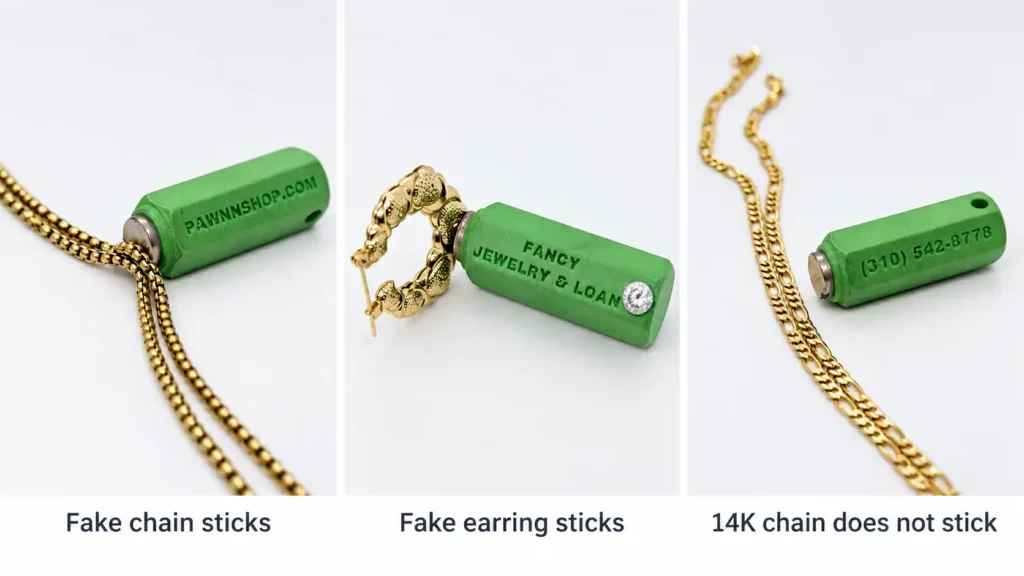
One of the most common at-home tests is the magnet test.
Gold itself is not magnetic, so if a piece strongly sticks to a magnet, that can be a warning sign.
The magnet test is good for quickly identifying obvious non-gold base metals in some jewelry. If a chain or earring is strongly attracted to a magnet, that often suggests the piece is fake, plated, or contains a substantial amount of non-gold metal.
Just because something sticks to a magnet does not automatically mean the whole piece is fake, and just because something does not stick does not prove it is real.
For example, most clasps have springs or internal components, and certain bangles or other pieces may contain small hardware parts that stick to a magnet.
Best Use: Quickly screening an item. If it sticks strongly, it may not be gold. If it doesn’t stick, it might be worth taking a closer look at.
This is a simple test that can sometimes provide a useful clue.
Rub the piece in your hands for a moment and then smell it.
If it has a strong metallic or penny-like smell, that can be a sign the piece contains exposed base metals rather than gold throughout.
Gold itself does not usually produce the strong “coins” or “pennies” smell people associate with some base metals.
This is still not a conclusive test. Surface contamination, wear, skin oils, repairs, and mixed-metal construction can all affect what you notice. Some plated items may also smell more metallic once the outer finish has worn.
Best use: DIY at home test, one more clue, especially when combined with visible wear, suspicious color, magnet attraction, or questionable hallmarks.
Not reliably.
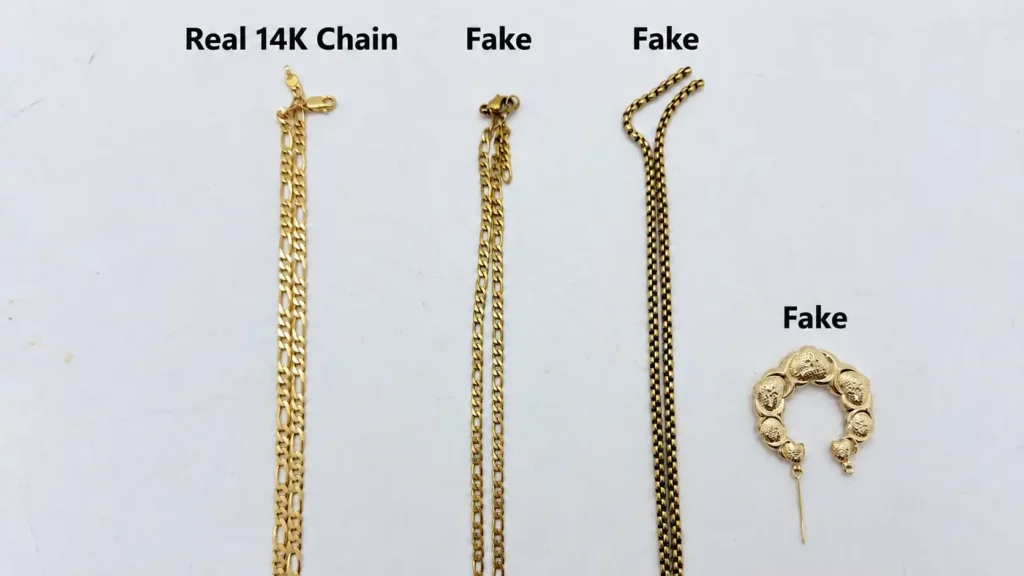
Gold jewelry comes in different shades depending on the alloy mix. Real gold can appear rich yellow, softer yellow, slightly pale, warmer, deeper, or simply different from another piece with the same karat rating.
That is because gold is commonly mixed with other metals, and those metals affect the final color.
Color can still offer useful clues. For example, plated jewelry can sometimes have a very bright yellow or slightly greenish tone. More importantly, look for signs that a surface layer is wearing away.
Some fake items are easy to spot by color. Others are not. Color is worth paying attention to, but it should never be used by itself as proof.
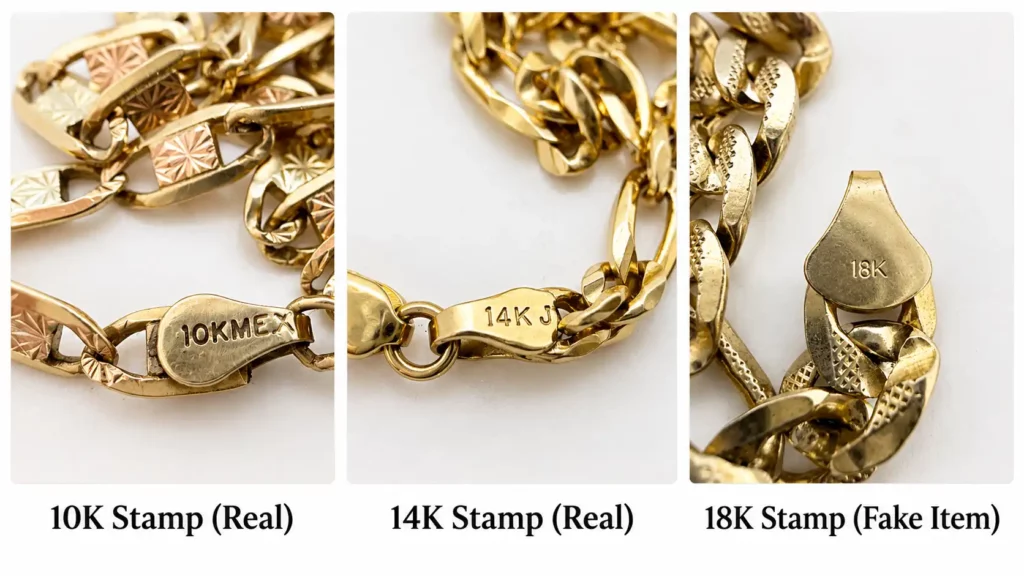
A hallmark is a stamp such as 10K, 14K, 18K, 417, 585, or 750. These marks are intended to indicate gold content.
| Karat | Common marks | Gold content |
|---|---|---|
| 10K | 10K, 417 | About 41.7% |
| 14K | 14K, 585 | About 58.3–58.5% |
| 18K | 18K, 750 | 75% |
| 22K | 22K, 916, 917 | About 91.7% |
| 24K | 24K, 999, 999.9 | Pure or near-pure gold |
The percentages are rounded. A 585 stamp means 58.5% gold; dividing 14 by 24 gives about 58.3%. Testing helps establish the purity used for an actual offer.
A hallmark can point you in the right direction. It may tell you what karat the piece claims to be, what standard it may have been made to, and whether it is worth closer testing.
We have encountered real gold pieces with no hallmark, pieces stamped 18K that tested lower, pieces stamped 14K that turned out to be fake, and plated items carrying misleading stamps.
That is why we treat a stamp as a clue rather than final proof.
Some genuine items may be unstamped because they are older, worn, repaired, handmade, foreign-made, irregularly manufactured, or simply made under a different standard than what most U.S. shoppers are used to seeing.
Best use: identify the claimed purity, then verify it with other evidence.
For everyday jewelry buying, touchstone acid testing remains one of the most useful and reliable practical verification methods, especially when combined with other clues.
A small sample of the metal is rubbed onto a testing stone to create a streak. That streak is then exposed to an acid selected for a specific karat range.
This test gives you something very important: a direct reaction from the metal itself. It can help show whether the piece is actually gold and, in many cases, whether the claimed karat makes sense.
A touchstone test is not simply making a scratch and adding acid. To do it well, you need to use the correct acid, make a useful streak, clean the stone between tests, compare known reactions, and recognize when a deeper sample is needed.
Gold-filled items can sometimes pass a very light surface test because the sample may only contain the outer gold layer. If there is doubt, a more deliberate sample from an appropriate area may be needed to understand what is underneath.
A properly performed touchstone test uses a very small, controlled sample, typically from a discreet area. The goal is to get enough information to evaluate the metal without causing unnecessary visible damage.
Best use: practical verification of gold content and karat, especially when surface appearance or markings are not enough.
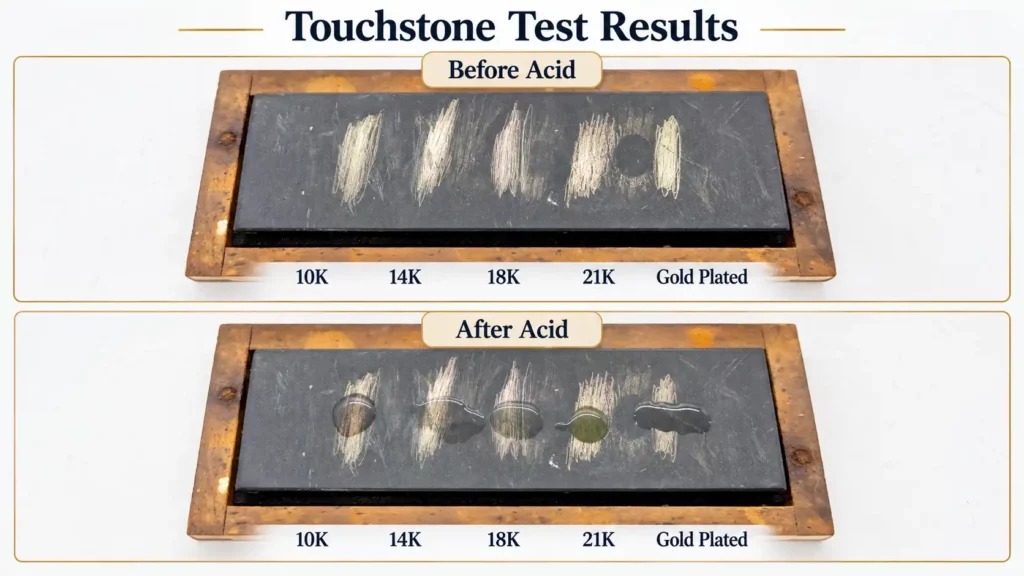
The item may be consistent with that karat range.
The item may be lower karat or not gold.
The sample is likely not consistent with the claimed purity.
More sampling or another test may be needed.
XRF (X-Ray Fluorescence) testing is a modern and very useful tool. It can provide a fast, non-destructive analysis of the elemental composition at or near the surface of a piece. It works by shining high-energy x-rays at a sample, causing the sample to release a sort of “fingerprint” that reveals what metals are present in a piece.
XRF does not analyze the core of the piece. It only analyzes the surface of the piece.
That matters because plated and gold-filled jewelry can have a gold-rich surface while a different metal exists deeper inside the item. A convincing surface reading does not always tell you what the entire piece is made from.
A surface reading is useful. A chemical reaction from a physical sample is useful. Visual inspection is useful. Hallmarks and magnet response are useful. Each provides a different part of the picture.
We do not see XRF and touchstone testing as competing methods. XRF is a powerful tool, and touchstone testing is a powerful tool. The best choice depends on what question needs to be answered.
Best use: Determining the estimated karat of a piece, to be verified with other tests.
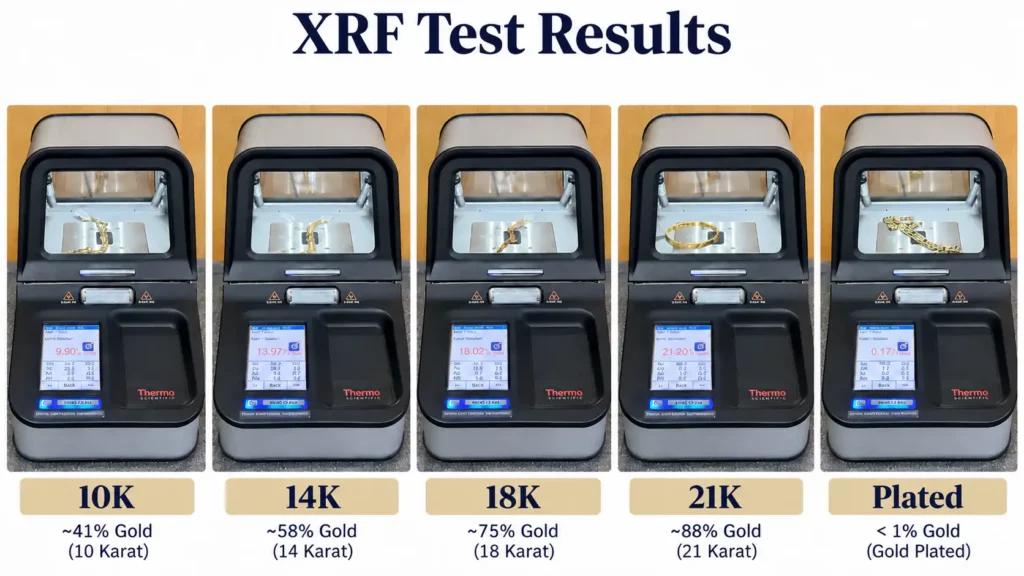
These methods answer different questions, which is why they can work well together.
Best for: real-world verification and comparing karat reactions.
Limitation: requires proper technique and a meaningful sample.
Best for: learning about the specific karat of the jewelry piece
Limitation: XRF can only penetrate about 4-20 microns deep, meaning items with a heavier plated items may report as solid gold.
This is probably the most important takeaway in the article.
When we test jewelry, we do not usually look for one magical test that answers everything.
Instead, we ask:
A fake stamp can mislead you. A convincing color can mislead you. A surface XRF reading can mislead you. A very light scratch can mislead you.
When multiple independent clues line up, confidence in the result becomes much stronger. When they conflict, that usually means the piece deserves a closer look.
There are a few other methods worth knowing about, even if they are not the main tests most everyday consumers use.
Density testing can help evaluate whether an object is consistent with the expected density of a metal.
It can be useful when the mass and volume can be measured accurately, but jewelry often contains hollow sections, stones, clasps, solder, mixed parts, or irregular shapes that complicate the result.
Best use: suitable objects with simple construction and reliable measurements.
Fire assay is a highly accurate laboratory method used to determine precious-metal content.
The major tradeoff is that it is destructive. A sample has to be removed and processed, which makes it impractical for most people who simply want to know whether an intact ring, chain, or bracelet is real.
Best use: definitive laboratory analysis when destructive sampling is acceptable.
Not necessarily. Stamps can be wrong, misleading, counterfeit, or applied to plated pieces.
Not true. Some genuine gold items are unstamped, especially older, handmade, repaired, worn, or foreign-made pieces.
Not necessarily. Many non-gold metals are also nonmagnetic, so passing a magnet test only removes one warning sign.
Not always. XRF is extremely useful, but it analyzes the surface or near-surface rather than the entire cross-section of a piece.
A properly performed touchstone test is controlled and minimal, and the amount of sampling can be adjusted to what needs to be verified.
Sometimes color provides a clue, but genuine gold alloys can vary widely in appearance.
If you think you might have gold, or you are simply not sure, bring it by.
We test gold regularly and see everything from clearly marked retail jewelry to unusual, unstamped, foreign-made, repaired, plated, and misleading pieces. Sometimes the answer is obvious. Sometimes it takes multiple clues and more than one test.
If you want a real-world opinion based on how gold is actually evaluated, we would be happy to take a look.
Yes. Some real gold pieces are unstamped, especially older, handmade, repaired, worn, or foreign-made jewelry.
Yes. A stamp is only a clue, not proof. The metal itself still needs to support what the stamp claims.
Gold itself is not magnetic, but some jewelry pieces may contain non-gold components such as clasp springs or internal hardware.
XRF is a very useful tool, but it should not always be used by itself. It works best as part of a broader testing process.
A properly performed touchstone test is usually minimal and controlled, and it is typically done in a discreet area.
Not reliably. Color and appearance can provide useful clues, but they are not enough by themselves.